Birmingham Blitz
Pamela's WarThe Birmingham Blitz is the wartime bombardment that turns Birmingham and its suburbs from an urban industrial setting into a landscape of recurring danger and forced displacement. Because the city’s factories manufacture aeroplanes, bombs, and guns, it becomes the third most bombed city in Britain, after London and Hull. The attacks do more than damage buildings: they alter how people understand distance, shelter, home, news, and community, bringing the war from the horizon into the family’s own rooms.
Industrial City Under Attack
The scale of the bombing is initially concealed from the public. Radio reports refer only vaguely to an air raid in a Midlands town, withholding the city’s identity so that neither civilians nor the enemy will know the full extent of events. The uncertainty is intensified by William Joyce’s broadcasts from Germany. Known as Lord Haw Haw, he supplies more information about the war than the British Government is prepared to share, mocks British leaders, and questions reported victories; his apparent knowledge makes the danger feel still greater. Birmingham’s industrial role nevertheless makes it a conspicuous target, and the nightly raids eventually reach what the narrator describes as terrifying proportions.
The contrast between rural safety and urban exposure gives the Birmingham Blitz its decisive geographical movement. During the earlier period at The Woodman Hotel, the family inhabit a countryside setting near a lane leading towards the Clent Hills. The hotel’s elevated bar even provides a practical vantage point over the police station opposite: Pamela Wheeler Fellows can see the police sergeant put on his helmet and thereby warn the bar to close before licensing hours are exceeded. The same local spaces also support wartime activity rather than being merely passive scenery. Father drills the young Home Guard on the field behind the police station, while soldiers stationed nearby operate a searchlight against German bombers and bring their rations to the hotel for Mother to cook. The countryside remains connected to the war, but it has not yet become the family’s immediate battlefield.
From Distant Glow to Immediate Threat
The turning point comes when Coventry is blitzed on 14 November 1940. From forty miles away, the family can see the glow of the fires lighting the night sky, bright enough to show that the attack is exceptionally serious. Wave after wave of bombers continues for hours, setting the medieval city alight and killing many thousands in their homes. The attacks on Coventry and other beautiful cities, including Bath, Canterbury, York, Norwich, and Exeter, are understood as assaults on both people and architectural heritage. Yet the intended submission does not follow. Shared danger instead draws strangers closer, even as the bombing divides families through the evacuation of children into the countryside and leaves some separations damaging to family relationships.
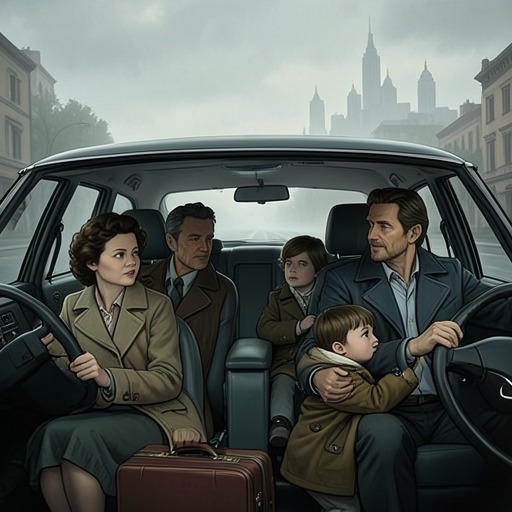
The family then abandons The Woodman Hotel and moves into a leased top-floor mansion flat about half a mile from Birmingham city centre. The decision carries an unmistakable reversal: they leave relative rural safety for a city whose bombing is increasing nightly. Their new home is elegant and spacious, with high ceilings, cornicing, and views over Islington Row and much of the city. Mother’s taste makes the newly furnished apartment beautiful despite wartime shortages, but the journey has already passed bombed-out buildings, turning the flat’s comfort into a fragile promise. The city is no longer something glimpsed from afar; it is the dangerous territory into which the family has chosen, or been compelled, to enter.
The Air Raid and the Loss of Home
The family’s first air raid in the new flat is nearly their last. When the bombing begins, the air-raid shelter is inaccessible, so the residents of the building gather on the ground floor. Father, drawing on his earlier experience as an officer, orders everyone onto the floor with their hands over their ears. They obey without question, and the position saves their lives: later inspection shows that most of the shrapnel holes are at waist or head height, where anyone standing would have been struck.
Survival does not mean safety. Father and John climb towards the top floor through the stairwell, which is filled with shards from the blown-out windows because the lift can no longer be used. The inspection reveals that the apartment has been wrecked. Every window is gone; the curtains hang in tatters against the broken glass; and the cabinet containing Mother’s china and glass has fallen over, smashing its contents. The blast that destroys the shelter also tears a substantial hole in the side of the building and removes part of the roof, leaving the block unfit for habitation.
The material consequences are brutally exact. The family can rescue only the suitcases they had not yet had time to unpack. Their possessions are reduced to a few clothes, a pair of shoes, a few books, and some letters. They own little more than what they are wearing and carrying. The Birmingham Blitz therefore changes the meaning of home in a single raid: the elegant flat becomes an uninhabitable shell, and the family becomes part of the population displaced by bombing. Pamela Wheeler Fellows begins to shake and continues shaking for a very long time, making bodily aftershock the final measure of the raid’s violence.
War Reconfigured as Social Space
The Birmingham Blitz does not leave every local space emptied; instead, it reassigns each one a wartime function. The lane opposite The Woodman Hotel leads towards the Clent Hills and a large property whose extensive grounds supply vegetables for local sale, while the hotel bar becomes an observation point over the police station. From there, Pamela Wheeler Fellows can watch the police sergeant put on his helmet and warn the customers that licensing hours are about to end, allowing the bar to cover its beer pulls, lower its shutters, and close in time. The arrangement turns an ordinary window into a system of surveillance and mutual adaptation, with official authority and private livelihood facing one another across the road.
The field behind the police station, once used for cricket, becomes a training ground for the local Home Guard. The battalion is composed largely of young village men too young to enlist, and its first equipment is limited to Government-issued armbands marked LDV, later replaced when the initials are mocked as “Look, Duck & Vanish.” Father drills them from the hotel, his commands carrying through the open windows. Their shortage of weapons makes the training visibly improvised: broom handles substitute for rifles, while shotguns, pistols left over from the previous war, and even pitchforks are contemplated for an emergency involving a German parachutist. Nevertheless, the young men treat the protection of Clent and the surrounding area as a grave responsibility, patrolling the hills at night despite their inadequate uniforms and equipment.
A field roughly half a mile from the hotel houses another wartime outpost, where a battalion of young soldiers operates a searchlight against German bombers. Their military task is important, but their inability to prepare edible meals produces a different kind of connection with the hotel. Mother learns of their difficulty and offers to cook the joints of meat they deliver to the kitchen. The soldiers then march across the field in single file, sit around a large table, and eat a proper meal; drinks follow naturally in a building licensed to sell intoxicating liquor. Her contribution is modest beside the industrial and military machinery of the war, yet it makes the hotel a place of nourishment as well as business, binding civilian hospitality to the wider war effort.
These transformations also expose the widening reach of danger. The bombing of Coventry can be seen from forty miles away, while Birmingham’s own industrial importance draws the raids ever closer. The city’s factories manufacture aeroplanes, bombs, and guns, making Birmingham the third most bombed city in Britain, after London and Hull. Public information is deliberately narrowed to vague references to an air raid in a Midlands town, whereas William Joyce’s broadcasts from Germany seem to disclose more than the British authorities will admit. The result is a geography experienced through partial sight, guarded speech, distant fire, and sudden physical impact: people may be kept ignorant of the city’s name, but the destruction eventually enters their building and removes the possibility of treating the war as someone else’s locality.
Memory, Mourning, and Collective Survival
The Birmingham Blitz also reshapes emotional geography. Its violence is measured not only in ruined buildings but in the distance between those who remain and those who vanish. On 5 September 1941, during a wedding in Dudley, Pamela Wheeler Fellows is seized by an overwhelming sense of doom and becomes physically ill; she tells Gloria that she is certain David has just died, although she cannot explain how she knows. Her certainty proves correct, and the loss leaves her believing that her heart will break. Soon afterward, Max is killed in his Stirling bomber during a raid over Germany. The deaths belong to a wider pattern: of the original group of twenty young men who used to come for a drink, the number diminishes week by week, while official notices provide only the briefest details and forbid meaningful discussion of whether the missing are dead. The silence intended to protect morale instead magnifies the horror, turning absence itself into a recurring presence in the hotel and in the narrator’s memory.
Against such private grief, wartime society develops rituals and habits that make endurance possible. Radio broadcasts carry Churchill’s speeches, health advice from Charles Hill, comedy, and music into homes and workplaces, while programmes such as ITMA, Hi Gang, Music While You Work, and Workers Playtime supply laughter and communal singing amid shortages and deprivation. The shared enemy lowers ordinary reserve: strangers converse like old friends and offer one another lifts. In this sense, the Birmingham Blitz produces a contradictory social space. It destroys privacy, stability, and family continuity, yet it also creates practical solidarity, as civilians, soldiers, hotel workers, and local defenders occupy the same improvised network of shelter, food, warning, entertainment, and remembrance.
Aftermath and Historical Meaning
The Birmingham Blitz leaves its deepest mark in the unstable boundary between public victory and private loss. Even after the bombing has made refugees of the family, wartime life continues to demand displays of confidence, endurance, and collective celebration. On VE-Day, streets fill with trestle tables covered in colourful cloths, bunting looped between houses, Union Jacks, fireworks, bonfires, sandwiches, trifles, jelly, and cake made possible by food saved through the years of rationing. Yet the apparent release of national joy is sharply uneven. At John Fellows’s parents’ home, celebration is impossible because Rex Fellows has been missing for months, somewhere with his unit in Europe. A telegram addressed to W. B. Fellows arrives with the familiar terror attached to wartime military notices, threatening to convert uncertainty into the official language of death or disappearance. The contrast shows that the Birmingham Blitz cannot be contained within the dates or streets of the raids: its consequences persist in damaged homes, displaced families, bereaved communities, guarded communications, and memories that remain active after the guns and bombers have fallen silent. The city’s wartime geography is therefore also an emotional one, in which shelter and exposure, celebration and mourning, practical solidarity and irreparable absence occupy the same landscape.